
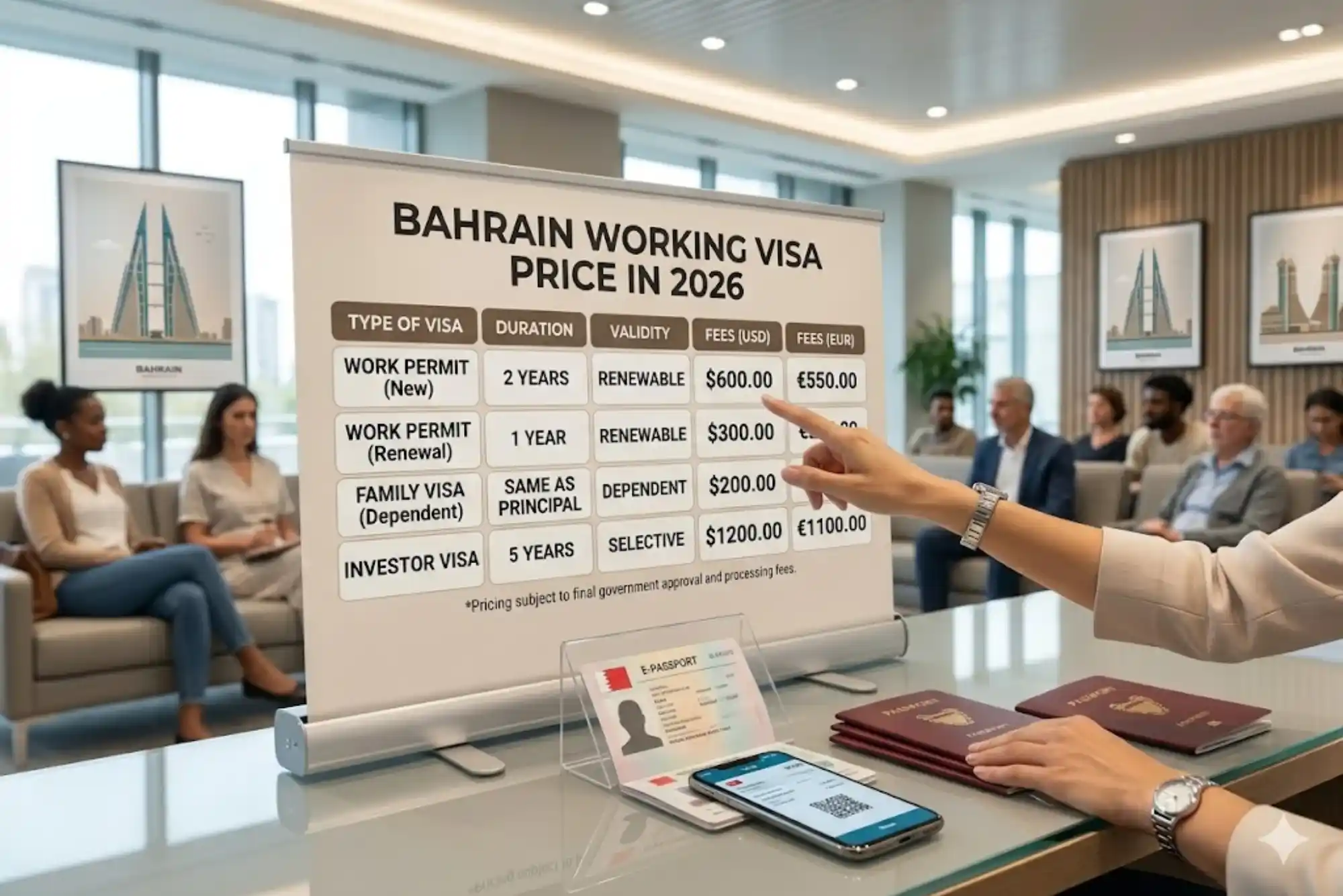
Bahrain has long been one of the Gulf region’s most accessible destinations for foreign workers, offering a relatively straightforward employment visa process compared to some of its neighbours. With a growing economy, a strong financial sector, and an expanding hospitality and construction industry, the demand for skilled and semi-skilled foreign labour remains consistent. For anyone planning to work in Bahrain in 2026, understanding the Bahrain working visa price — including every fee, government charge, and supporting cost involved — is the first practical step before accepting a job offer or beginning the application process.
How the Bahrain Work Visa System Works
Bahrain’s employment visa system is managed through the Labour Market Regulatory Authority, commonly referred to as LMRA. Unlike some Gulf countries where the employer holds complete control over the visa process, Bahrain introduced a flexible work permit system that allows workers more mobility between employers under certain conditions. This system, while worker-friendly in many respects, also involves a distinct fee structure that both employers and employees need to understand.
A work visa in Bahrain is typically initiated by the employer, who applies for a work permit on behalf of the incoming foreign employee. Once the work permit is approved by LMRA, the employee then applies for a residence visa and work visa stamp, which allows them to live and work legally in Bahrain. The total cost of this process is split across multiple stages, and the fees vary depending on the worker’s nationality, skill level, and the sector they will be employed in.
Bahrain Working Visa Price in 2026: Quick Answer
The total cost of a Bahrain working visa in 2026 ranges from BHD 150 to BHD 400 (approximately USD $400 to USD $1,060) depending on the visa category, worker nationality, employer levy obligations, and associated medical and document costs. Some fees are borne by the employer, while others are the responsibility of the employee. The breakdown below covers both sides of the cost equation.
Complete Fee Breakdown: Bahrain Work Visa Costs in 2026
The Bahrain working visa involves several distinct fee components at different stages of the process. Here is a detailed look at each charge you can expect to encounter.
| Fee Component | Amount (BHD) | Amount (USD Approx.) | Paid By |
|---|---|---|---|
| LMRA Work Permit Fee (Skilled Worker) | BHD 48 per year | Approx. $127/year | Employer |
| LMRA Work Permit Fee (Unskilled / Semi-skilled) | BHD 72 per year | Approx. $191/year | Employer |
| Residence Visa Application Fee | BHD 25 – 50 | Approx. $66 – $133 | Employer / Employee |
| CPR (Central Population Registration) Card | BHD 3 – 5 | Approx. $8 – $13 | Employee |
| Medical Fitness Test (in home country) | Varies by country | Approx. $30 – $80 | Employee |
| Medical Examination (upon arrival in Bahrain) | BHD 15 – 25 | Approx. $40 – $66 | Employee or Employer |
| Health Insurance Premium | BHD 50 – 150 per year | Approx. $133 – $397 | Employer (mandatory) |
| Document Attestation / Authentication | Varies | Approx. $40 – $120 | Employee |
| Visa Stamping Fee | BHD 10 – 20 | Approx. $26 – $53 | Employee / Employer |
| Agent / PRO Service Fee (if applicable) | BHD 20 – 60 | Approx. $53 – $159 | Employer / Employee |
| Total Estimated Cost (Employee Side) | BHD 50 – 120 | Approx. $133 – $318 | Employee |
| Total Estimated Cost (Employer Side) | BHD 100 – 280 | Approx. $265 – $742 | Employer |
It is important to note that under Bahrain’s labour law, employers are generally prohibited from passing the LMRA work permit levy and health insurance costs onto employees. However, documentation costs, medical fitness tests in the home country, and attestation charges are typically the employee’s responsibility. Always confirm with your employer before travel which specific costs each party will cover. For those comparing employment costs across Gulf destinations, reviewing detailed travel and visa pricing guides for the region can help you evaluate Bahrain against other options.

LMRA Levy Structure: Skilled vs. Unskilled Workers
The LMRA annual levy is one of the most important cost components to understand, as it determines how much your employer is obligated to pay per year for each foreign worker they sponsor. The levy rate differs based on the worker’s classification and, in some cases, the ratio of Bahraini to foreign employees within the company.
| Worker Category | Annual LMRA Levy (BHD) | Annual LMRA Levy (USD Approx.) |
|---|---|---|
| Skilled Worker (university educated or specialised trade) | BHD 48 | Approx. $127 |
| Unskilled / Semi-skilled Worker | BHD 72 | Approx. $191 |
| Domestic Worker | BHD 24 | Approx. $64 |
| Worker in Bahraini-majority workforce companies | Reduced levy (varies) | Subject to LMRA calculation |
Companies with a higher ratio of Bahraini employees relative to foreign workers may qualify for reduced levy rates as part of Bahrain’s Bahrainisation initiative. These rates are determined by LMRA on a case-by-case basis and are the employer’s responsibility to apply for and maintain.
Documents Required for Bahrain Work Visa Application
Whether you are applying from your home country or your employer is handling the process from Bahrain, you will need to ensure the following documents are prepared and verified before the visa can be issued.
- Valid passport with at least six months remaining validity
- Completed work visa application form
- Passport-size photographs meeting Bahrain’s official specifications
- Employment contract signed by both the employer and employee
- Educational certificates or professional qualification documents (attested)
- Medical fitness certificate from an approved medical centre in your home country
- Police clearance certificate from your home country
- LMRA-approved work permit issued in Bahrain by your employer
- Health insurance policy confirmation from your employer
- Copy of your employer’s commercial registration in Bahrain
Document attestation is a critical and often overlooked part of the process. Educational certificates and experience letters must typically be attested by the Ministry of Foreign Affairs in your home country and then verified by the Bahraini embassy or consulate. This process can take one to three weeks and involves additional costs that should be factored into your total budget. For those also looking into what life in Bahrain offers beyond the workplace, exploring top things to do and experience in Bahrain can help you settle into the country with a broader perspective from day one.
How Long Does It Take to Get a Bahrain Work Visa?
The processing timeline for a Bahrain work visa in 2026 typically follows this sequence once all documents are in order and the employer has initiated the process through LMRA.
| Process Stage | Estimated Timeframe |
|---|---|
| LMRA Work Permit Approval | 3 – 10 working days |
| Visa Entry Permit Issuance | 3 – 7 working days after work permit |
| Visa Stamping at Bahraini Embassy (home country) | 3 – 7 working days |
| Arrival and Medical Examination in Bahrain | Within 2 weeks of arrival |
| CPR Card Issuance | 2 – 5 working days after medical clearance |
| Residence Visa Stamping | 1 – 3 working days after CPR |
| Total End-to-End Timeline | 4 – 8 weeks (average) |
The timeline assumes no delays in document submission or additional verification requirements. Applications from nationalities that require additional security clearance may take longer. Employers who use a licensed PRO (Public Relations Officer) service to manage the process often experience faster turnaround, which is reflected in the PRO service fee listed in the cost breakdown above.
Flexible Work Permit: Bahrain’s Alternative Visa Option
Bahrain introduced a Flexible Work Permit (FWP) as an alternative to the traditional employer-sponsored work visa. This permit allows foreign nationals to work for multiple employers without being tied to a single sponsoring company. The FWP was designed to reduce illegal employment and give workers more control over their employment situation.
The Flexible Work Permit costs approximately BHD 300 per year (around USD $795) and is self-sponsored, meaning the worker pays for it independently without employer support. While more expensive than a traditional sponsored work visa, it offers significantly greater employment flexibility and is particularly useful for freelancers, skilled contractors, or those who work across multiple clients or projects in Bahrain. According to official LMRA guidelines [Insert relevant reference link here], the FWP holder must still comply with Bahrain’s labour laws and tax registration requirements where applicable.
Hidden and Additional Costs to Plan For
Beyond the visa-related fees, workers relocating to Bahrain should budget for several additional expenses that are part of the practical reality of establishing life in the country. These are not visa costs per se, but they directly affect the total financial outlay in the first few months of employment.
- Accommodation deposit and first month’s rent (typically BHD 150 – 500 depending on area)
- Transportation setup costs including driving licence conversion if applicable
- Mobile phone registration and SIM setup
- Bank account opening requirements and initial deposit
- Cost of living adjustment during the first month before first salary payment
- Return ticket costs if the employer does not provide travel allowance
Many employers in Bahrain offer relocation packages that cover some or all of these initial costs. It is worth clarifying what your employment contract includes before arrival to avoid surprises. Understanding how fees and charges work across different financial services can also be useful during your relocation, and reading about international payment and fee structures may help you manage cross-border financial transactions during your transition to Bahrain.
Who Pays the Bahrain Work Visa Fees: Employer or Employee?
This is one of the most commonly asked questions by workers preparing to move to Bahrain. The legal position under Bahrain labour law is relatively clear, but practical arrangements can sometimes differ from what the law technically requires.
Employer’s legal obligation: LMRA work permit levy, health insurance, residence visa processing, and work permit renewal fees
Employee’s typical responsibility: Medical fitness test in home country, document attestation, passport photos, CPR card fee, and personal travel costs
Negotiable or shared costs: Agent or PRO service fees, visa stamping charges, and certain administrative costs
Workers should be cautious of any employer who asks them to pay the LMRA levy or health insurance costs out of pocket, as this is a violation of Bahrain’s labour regulations. If your employer asks you to bear costs that are legally their responsibility, consulting with the LMRA or a labour rights advisory service in Bahrain is the appropriate next step. For anyone still in the research phase of their Bahrain move and wanting broader context on planning an international work relocation, reviewing practical relocation and travel planning tips can help you approach the process more strategically.
Frequently Asked Questions
What is the Bahrain working visa price in 2026?
The total Bahrain working visa cost in 2026 ranges from BHD 150 to BHD 400 (approximately USD $400 to $1,060) when all fees are combined. The employee typically bears BHD 50 to BHD 120 in personal costs, while the employer covers the LMRA levy, health insurance, and residence visa processing fees as required by law.
How long is a Bahrain work visa valid?
A standard Bahrain work visa and residence permit is typically issued for one or two years and must be renewed before expiry. Renewal involves paying the LMRA levy for the next period and updating the residence stamp in your passport through the immigration authorities.
Can I change employers in Bahrain on a work visa?
Yes. Bahrain’s labour law allows workers to transfer their employment sponsorship to a new employer under specific conditions, primarily after completing a defined period with the original employer or with their consent. The LMRA manages these transfers and charges an administrative fee for processing the change.
What is the Flexible Work Permit in Bahrain and how much does it cost?
The Flexible Work Permit (FWP) is a self-sponsored work authorisation that allows foreign nationals to work for multiple employers in Bahrain without being tied to a single sponsor. It costs approximately BHD 300 per year (around USD $795) and is ideal for freelancers, contractors, or those seeking employment flexibility.
Is health insurance included in the Bahrain work visa cost?
Yes. Health insurance is a mandatory component of the Bahrain work visa process and is legally the employer’s responsibility to provide. The cost ranges from BHD 50 to BHD 150 per year depending on the policy level chosen by the employer. Workers should not be asked to pay this cost themselves.
The Bahrain working visa price in 2026 is a multi-layered cost shared between employer and employee, with the employer carrying the larger portion of the financial burden under Bahrain’s labour regulations. For employees, the out-of-pocket expenses are manageable — primarily centred around document attestation, medical fitness tests, and the CPR card.
Understanding which fees are your responsibility and which fall on your employer helps you negotiate your employment package more effectively and ensures you arrive in Bahrain without unexpected financial strain. With clear cost expectations and proper document preparation, the Bahrain work visa process is one of the more structured and transparent in the Gulf region — a reassuring starting point for anyone building a career there.
Related Reading: Azad Visa Dubai Price in 2026: Updated Fees and Complete Price Breakdown
Related Reading: American Holiday Visa Price in 2026: Updated Fees and Complete Price Breakdown