Dubai has become one of the most sought-after long-term destinations in the world — not just for tourists passing through, but for professionals, investors, freelancers, and families who want to build a life in one of the UAE’s most dynamic cities. For anyone planning an extended stay, understanding the 2 years Dubai visa price is one of the first practical questions that needs a clear answer. Visa fees in the UAE can vary significantly depending on your visa type, how you apply, which service provider you use, and what additional costs come into play during the process. This guide breaks it all down so you can plan your move or extended stay with accurate budget expectations.
What Is the 2 Year Dubai Visa?
The UAE offers several long-term visa options, and the two-year visa has become particularly popular among professionals, skilled workers, and family members of UAE residents. It allows holders to live, work, or stay in Dubai for an extended period without the repeated expense and inconvenience of shorter-term renewals.
The most common route to a two-year Dubai visa is through employment sponsorship, where a UAE-based employer sponsors the employee and their dependents. However, freelancers with a UAE-issued freelance permit, investors, and individuals who qualify under certain residency programmes can also access two-year visa options through different channels. Each pathway carries its own fee structure, processing timeline, and documentation requirements.
It is worth noting that the UAE’s long-term visa landscape also includes the ten-year Golden Visa, but the two-year residence visa remains the most widely issued option for workers and their families coming through standard employment channels.
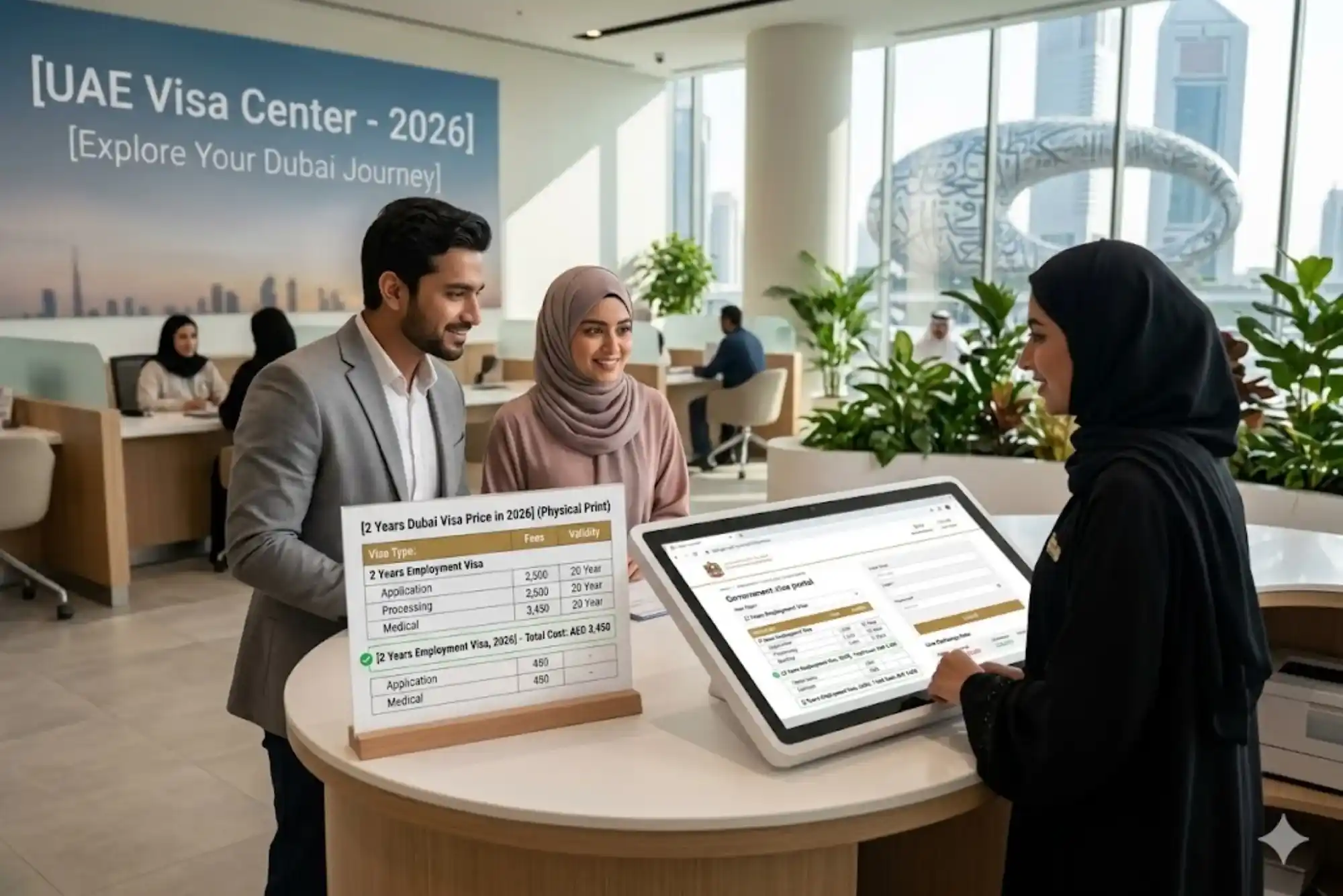
2 Years Dubai Visa Price in 2026: Fee Breakdown
The total cost of a 2-year Dubai visa is not a single flat figure. It is made up of several individual charges that are collected at different stages of the application process. Understanding each component helps you avoid budget surprises and prepare the correct amount before you begin.
The fees listed here reflect general ranges based on standard employment-based residence visas processed through official UAE government channels and authorised typing centres. Exact figures can vary depending on your nationality, the emirate where the visa is processed, the sponsoring employer’s classification, and whether you opt for standard or priority processing. Always verify current fees through the General Directorate of Residency and Foreigners Affairs (GDRFA) or an authorised UAE PRO service. [Insert relevant reference link here]
| Fee Component | Estimated Cost (AED) | Notes |
|---|---|---|
| Visa Application / Entry Permit Fee | 500 – 700 | Initial entry permit to allow you to enter UAE for visa stamping |
| Status Change Fee (if inside UAE) | 620 – 750 | Applicable when changing visa status from visit/tourist to residence |
| Medical Fitness Test | 250 – 320 | Mandatory blood test and chest X-ray at approved health centres |
| Emirates ID Application Fee | 370 – 400 | 2-year Emirates ID card; required for all residents |
| Residence Visa Stamping Fee | 500 – 700 | Official residence visa stamped in passport |
| Insurance (if not employer-provided) | 600 – 1,500+ | Health insurance is mandatory for residence visa holders in Dubai |
| Typing Centre / Service Fee | 150 – 300 | Processing and form submission through authorised typing centres |
| Priority Processing (optional) | 500 – 1,000 | Expedited processing for faster turnaround if needed |
Based on the breakdown above, the total estimated cost for a standard two-year Dubai residence visa — excluding health insurance if employer-provided — typically falls in the range of AED 2,400 to AED 3,500 for an individual. When health insurance is included at the applicant’s expense, the total can rise to AED 3,000 to AED 5,000 or more depending on the coverage level chosen.
Employer-Sponsored vs Self-Sponsored: Which Costs More?
The pathway you use to obtain the two-year Dubai visa significantly affects what you personally pay. Under employer sponsorship, the majority of visa fees are typically covered by the company. UAE labour law requires employers to bear the cost of the employee’s residence visa, medical test, and Emirates ID. In practice, some employers absorb all these costs while others deduct a portion from the employee’s first salary — so it is worth clarifying this arrangement before accepting a job offer.
For self-sponsored individuals — such as freelancers operating under a UAE freelance permit or sole proprietorship licence — all fees are paid out of pocket. The process is similar but without the employer covering any portion of the cost. Freelancers in Dubai should budget for the full fee range outlined in the table above, plus any costs associated with maintaining their trade licence or freelance permit, which is a separate annual expense.
Investors and business owners applying for a two-year visa through their company licence also fall into the self-sponsored category for cost purposes, though the specific fee structure may differ slightly based on the free zone or mainland authority through which their business is registered.
Dependent Visa Costs: Sponsoring Family Members
Many people applying for a 2-year Dubai residence visa also want to sponsor their spouse, children, or parents. Each dependent requires their own visa application, medical test, and Emirates ID — which means the costs multiply accordingly.
| Dependent Type | Estimated Additional Cost per Person (AED) | Key Requirement |
|---|---|---|
| Spouse | 2,500 – 4,000 | Marriage certificate (attested); salary threshold for sponsorship |
| Children (under 18) | 2,000 – 3,500 per child | Birth certificate (attested); school enrolment for school-age children |
| Children (18–21, students) | 2,000 – 3,500 | Proof of enrolment in accredited institution |
| Parents | 3,000 – 5,000 | Higher salary threshold required; relationship proof (attested) |
To sponsor a spouse or children, the primary visa holder typically needs to earn a minimum monthly salary — the specific threshold varies based on which dependents are being sponsored and whether accommodation is included in the employment package. Sponsoring parents requires a higher income threshold and is subject to additional requirements.
Required Documents for the 2 Year Dubai Visa Application
Having the right documents prepared in advance significantly reduces delays and avoids the frustration of incomplete applications being rejected or returned. The standard document checklist for a two-year residence visa in Dubai includes:
- Valid passport with at least six months of remaining validity
- Recent passport-sized photographs on a white background (specific size requirements apply)
- Completed visa application form (typically submitted through an authorised typing centre)
- Employment contract or appointment letter (for employer-sponsored applicants)
- Trade licence copy (for self-employed or business owner applications)
- Tenancy contract (Ejari-registered) or proof of accommodation
- Medical fitness test results from an approved UAE health centre
- Health insurance policy document
- Entry permit (if applying from outside the UAE and entering for visa stamping)
Documents originating from outside the UAE — such as marriage certificates, birth certificates, or educational qualifications — generally need to be attested by your home country’s relevant authority and then verified by the UAE Ministry of Foreign Affairs before they are accepted for visa purposes.
How Long Does the 2 Year Dubai Visa Process Take?
Processing times for the Dubai two-year residence visa vary depending on the type of application and the channel used. Under standard processing, the full cycle from initial entry permit to residence visa stamping typically takes between two and four weeks, assuming all documents are in order and no additional verification is required.
The medical test results are usually available within two to four working days. Emirates ID card production takes approximately five to seven working days after the biometrics appointment. Priority processing options, available for an additional fee, can compress the timeline for certain stages — though medical test results cannot be expedited.
Applicants who are already inside the UAE on a valid visit or tourist visa can complete the entire process locally through a status change, avoiding the need to exit the country. Those applying from outside the UAE typically receive an entry permit first, which allows them to enter and complete the remaining steps on arrival.
Tips to Avoid Overpaying on Your Dubai Visa
The official UAE government fees are fixed, but the total you pay can vary depending on how and where you process your application. A few practical considerations can help you manage costs:
- Use GDRFA-authorised typing centres — unauthorised agents often charge inflated service fees without providing any additional benefit
- Clarify with your employer exactly which fees they cover before starting the process, so you know precisely what you will need to pay personally
- Compare health insurance options before purchase — premiums vary widely for similar coverage levels among Dubai Health Authority-approved insurers
- Avoid unnecessary priority processing unless your timeline genuinely requires it — the standard process is usually sufficient when documents are complete
- Check whether your documents are already attested correctly before submitting — re-attestation and re-submission add both time and cost
Planning your budget early and understanding the full fee structure before you begin is the most effective way to avoid cost overruns. For those also budgeting for transportation and practical living costs during their move or extended stay, understanding how to find affordable services in the UAE can help you manage your overall transition budget more effectively.
2 Year Dubai Visa vs Other UAE Visa Options
The two-year residence visa is the most common option for working professionals and their families, but it is worth briefly comparing it against other available categories to confirm it is the right fit for your situation.
| Visa Type | Duration | Best Suited For | Estimated Cost Range (AED) |
|---|---|---|---|
| Employment Residence Visa | 2 years | Employed workers and their dependents | 2,400 – 5,000+ |
| Freelance / Self-Employed Visa | 2 years | Freelancers with UAE permit | 3,000 – 6,000+ |
| Investor / Partner Visa | 2 years | Business owners and investors | 3,500 – 7,000+ |
| Golden Visa | 10 years | Highly skilled professionals, investors, researchers | 4,000 – 10,000+ |
| Tourist / Visit Visa | 30 – 90 days | Short-term visitors | 300 – 600 |
For most people relocating to Dubai for work, the standard two-year employment residence visa remains the most straightforward and cost-accessible route. The Golden Visa offers significant long-term advantages for those who qualify, but the eligibility criteria and initial costs are higher.
Travellers who want to explore Dubai before committing to a longer-term move will find useful planning resources in the destinations and places section, which covers practical guidance on visiting various locations. For those focused specifically on cost planning across different travel and living situations, the prices category provides additional fee and cost guides that complement the visa information covered here.
Frequently Asked Questions
Can I apply for a 2 year Dubai visa without a job offer?
Yes, through the freelance permit route, investor visa, or certain remote work visa programmes the UAE has introduced. These require you to have an existing income source and meet the relevant eligibility criteria. Without employer sponsorship, you will be responsible for covering all fees yourself and must meet the minimum financial threshold set by the relevant authority.
Is health insurance included in the Dubai visa fee?
Health insurance is mandatory for all Dubai residence visa holders but is not automatically included in the government visa fee. Employer-sponsored applicants may have insurance provided by their company. Self-sponsored applicants must purchase approved health insurance separately, which adds to the overall cost.
How much does it cost to renew a 2 year Dubai visa?
Renewal costs are similar to the initial application costs — typically in the range of AED 2,000 to AED 4,000 for an individual, including the medical test, Emirates ID renewal, and visa stamping fees. Health insurance must also be renewed annually regardless of the visa renewal cycle.
Can I stay in Dubai continuously for 2 years on this visa?
Yes, a two-year residence visa allows you to live continuously in the UAE for the full two-year period. However, if you leave the UAE for more than six consecutive months without returning, the visa may be cancelled automatically. Short international trips are generally fine as long as you return within this window.
What happens if my Dubai visa application is rejected?
Application rejections can occur due to incomplete documentation, failed medical tests, or issues with the sponsoring employer. Government fees already paid for rejected applications are generally non-refundable, though the specific policy can vary. Service fees charged by typing centres or PRO services are also typically non-refundable. Always ensure your documents are complete and accurate before submitting.
The 2 years Dubai visa price in 2026 is not a single number — it is a combination of government fees, medical costs, insurance, Emirates ID charges, and service fees that together form the total cost of establishing legal residence in the UAE. For most employment-based applicants, the realistic all-in cost ranges from AED 2,400 to AED 5,000 per person, with dependent visa costs adding to that figure for each family member sponsored. Understanding this full picture from the start allows you to plan your move accurately, avoid unexpected expenses, and navigate the process with confidence. Whether you are relocating for work, establishing a business, or building a life in this remarkable city, being financially prepared is the first and most practical step.
For broader travel planning and practical destination guidance to support your time in the UAE and beyond, exploring the tips and travel resources section can help you make the most of your experience from the moment you arrive.