
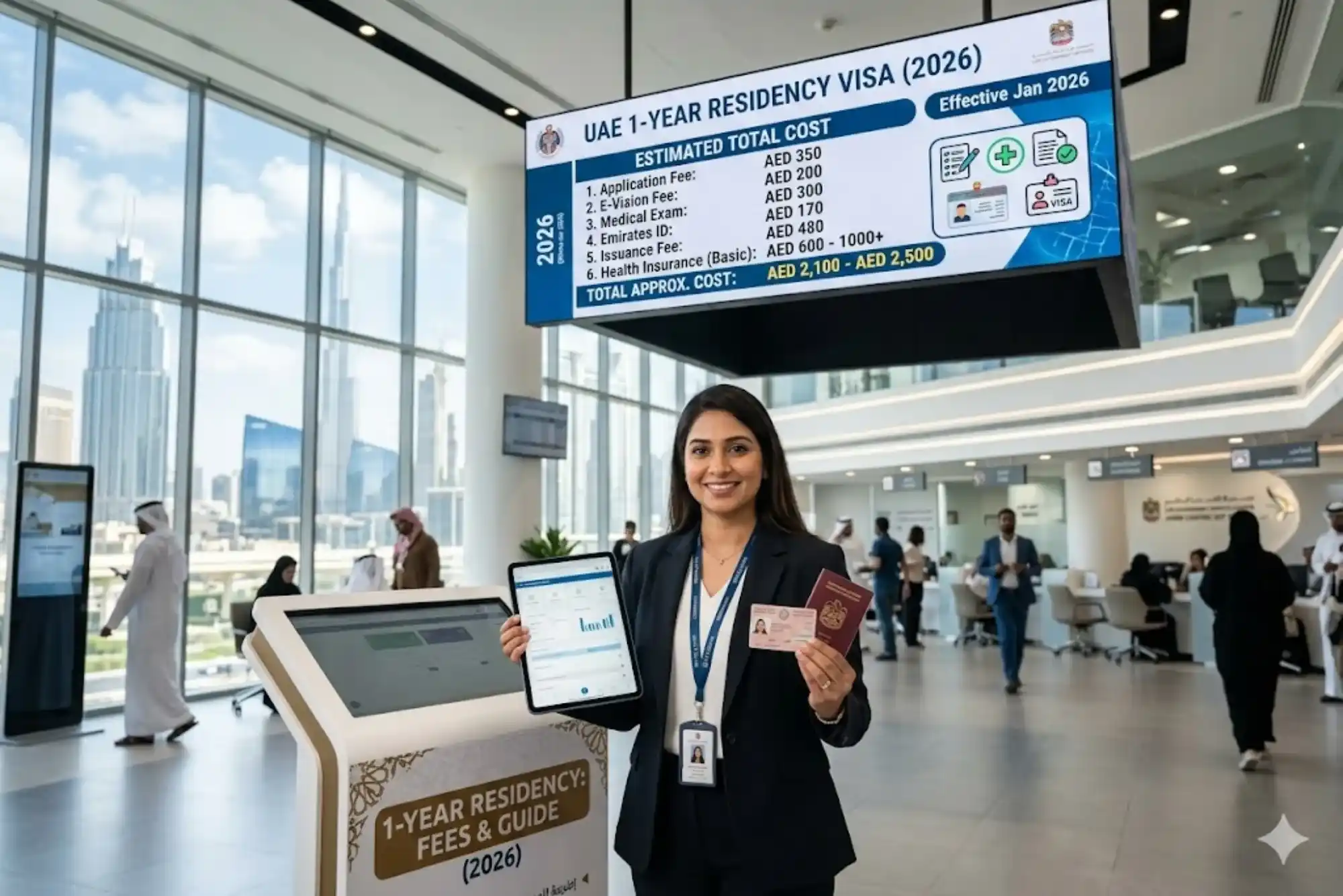
Planning to live or work in the UAE for an extended period means getting familiar with what the visa process actually costs — not just the headline figure, but every charge that adds up along the way. The 1 year visa UAE price in 2026 is not a single flat fee. It involves a combination of government charges, administrative costs, mandatory medical tests, Emirates ID issuance, and in some emirates, health insurance. This guide breaks all of it down clearly so you can budget accurately before you apply.
What Is a 1-Year UAE Residence Visa?
A 1-year UAE residence visa is a legal authorization that allows foreign nationals to live and work inside the United Arab Emirates for a period of 12 months. It is commonly issued to employees working for companies that prefer shorter-term contracts, freelancers in the early stages of establishing themselves, and individuals transitioning between longer visa terms.
While the standard residence visa in the UAE is often issued for 2 or 3 years, a 1-year variant remains available through certain employers and free zones. It functions the same way as any other residence visa — granting the holder the right to reside legally, open a bank account, access medical care, obtain a driving licence, and in eligible cases, sponsor immediate family members.
The visa is regulated and issued either through the Federal Authority for Identity, Citizenship, Customs and Port Security (ICP) or the General Directorate of Residency and Foreigners Affairs (GDRFA), depending on the emirate of application.
1 Year Visa UAE Price: Complete Fee Breakdown for 2026
The total cost of a 1-year UAE residence visa is made up of several distinct components. Each one is charged separately, and some are mandatory regardless of emirate or visa category. Below is a detailed breakdown of what to expect.
| Fee Component | Estimated Cost (AED) | Notes |
|---|---|---|
| Entry Permit / Initial Approval | 500 – 600 | Required to begin the residency process |
| Medical Fitness Test | 320 – 500 | Includes blood test and chest X-ray; mandatory for adults over 18 |
| Emirates ID (1-Year) | 270 – 370 | Lower rate applies for 1-year validity; biometrics collected at ID centre |
| Visa Stamping / Issuance | 500 – 600 | Government fee for the actual visa stamp or eVisa issuance |
| Status Change (inside UAE) | 570 – 650 | Only if converting from a visit or tourist visa without exiting the country |
| Typing Centre / Service Charge | 100 – 300 | Charged by the processing centre; varies by provider |
| Health Insurance (basic plan) | 600 – 1,200/year | Mandatory in Dubai and Abu Dhabi; varies by coverage tier |
| Express / Priority Processing | 200 – 800 | Optional; reduces processing time to 24–48 hours |
| Document Attestation | 150 – 500 per document | Required if applying from abroad; covers marriage, birth, and qualification certificates |
Based on these components, the total estimated cost for a standard 1-year UAE employment residence visa typically falls between AED 2,500 and AED 4,500, depending on the emirate, service provider, whether status change is required, and whether basic health insurance is factored in. Applicants who apply from outside the UAE may incur lower government fees on some charges but will face additional travel costs.

Government Fees vs. Service Centre Charges
One of the most commonly misunderstood aspects of UAE visa pricing is the difference between government fees and service centre charges. Government fees are fixed and set by the ICP or GDRFA. They are non-negotiable and consistent across official channels. Service centre charges, on the other hand, are set by the typing centre, immigration consultancy, or agency handling the application on your behalf.
This is why the same visa can appear to cost different amounts when quoted by different providers. Airlines such as Emirates and Etihad sometimes offer competitive visa processing rates to encourage passengers to book through them. Travel agencies tend to charge a premium but handle the entire paperwork process. Applying directly through the ICP portal or an Amer centre generally results in the lowest total cost.
If you are comparing UAE visa fees across platforms, always separate the government component from the service component to make an accurate comparison.
Medical Test Fees for UAE Residence Visa 2026
The medical fitness examination is a mandatory step for all residence visa applicants aged 18 and above. The test screens for communicable diseases including tuberculosis, hepatitis, and HIV. A fitness certificate confirming a clean result is required before the visa can be stamped.
| Medical Test Type | Cost (AED) | Processing Time |
|---|---|---|
| Standard Medical Test | 320 – 380 | Results in 24–48 hours |
| VIP / Fast-Track Medical Test | 500 – 700 | Results within a few hours on the same day |
The VIP option is worth considering during peak visa periods, such as the back-to-school season or year-end, when standard test queues tend to be longer and results may take additional time. The test must be completed at a UAE health authority-approved medical centre.
Emirates ID Cost for a 1-Year Visa
Every UAE residence visa holder is required to obtain an Emirates ID, which serves as the official identity card for the duration of their residency. The Emirates ID fee is directly linked to the visa validity period.
For a 1-year residence visa, the Emirates ID issuance fee is typically around AED 270 to AED 370, which is lower than the equivalent fee for a 2 or 3-year visa. The biometric data — fingerprints and photograph — is collected at the ID centre as part of the application process. Most applicants complete this step on the same day as their entry permit approval or after clearing the medical test.
Health Insurance Requirements and Cost
Since 2025, health insurance has been mandatory for all UAE residents, with particularly strict enforcement in Dubai and Abu Dhabi. The cost of a basic compliant plan starts at around AED 600 to AED 1,200 per year. Comprehensive plans with wider coverage can range from AED 3,000 to AED 20,000 annually depending on age, pre-existing conditions, and the level of coverage selected.
For employer-sponsored visa holders, the company typically arranges and pays for basic health insurance as part of the employment package. Freelancers, investors, and self-sponsored visa holders must arrange their own coverage independently before the visa can be processed or renewed.
Additional Costs to Factor Into Your Budget
Beyond the core fees, there are several additional charges that applicants often overlook when estimating the total cost of a UAE residence visa.
- Document attestation: If your degree, marriage certificate, or birth certificate needs to be attested for the UAE, budget AED 150 to AED 500 per document. This process involves attestation at your home country’s embassy and the UAE Ministry of Foreign Affairs (MOFA), and can take two to four weeks.
- Overstay fines: As of February 2026, overstay fines have been unified at AED 50 per day across all emirates for tourist, visit, and residence visas. The previous 10-day grace period has been removed, so fines accrue from day one of overstay.
- Courier charges: Some applications require physical document submission, which may attract courier costs.
- Knowledge and Innovation fee: A nominal fee levied by the government on certain transactions, typically AED 10 per service.
For travellers who are still planning their broader trip to the UAE, exploring travel price guides and cost breakdowns can help you budget comprehensively for accommodation, transport, and living expenses alongside your visa costs.
1-Year vs 2-Year vs 3-Year UAE Residence Visa: Which Is Better Value?
While 1-year visas serve a specific purpose, they are worth comparing against longer-term options to assess overall value. The government fees for a 2 or 3-year visa are not dramatically higher than for a 1-year visa, meaning longer validity often works out more cost-efficient per month of residency.
| Visa Duration | Estimated Total Cost (AED) | Best Suited For |
|---|---|---|
| 1 Year | 2,500 – 4,500 | Short-term contracts, freelancers, transitional residents |
| 2 Years | 3,500 – 6,000 | Standard employment, family sponsorship, mid-term residents |
| 3 Years | 3,700 – 5,500 | Longer contracts, cost efficiency over time |
| 5 Years (Green Visa) | 5,000 – 8,000+ | Skilled workers, freelancers with qualifying income |
| 10 Years (Golden Visa) | 4,600 – 10,250 | Investors, property owners, exceptional talent |
If your employer is willing to support a 2 or 3-year contract, the longer visa is generally the better financial decision over time, as it reduces the frequency of renewal fees, medical tests, and Emirates ID charges.
For those interested in the broader financial landscape of the UAE, understanding fee structures and service charges across different types of transactions can provide useful context when planning your finances as a resident.
How to Apply for a 1-Year UAE Residence Visa
The application process for a UAE residence visa follows a standard sequence regardless of the visa duration. Here is an overview of the key steps involved.
Confirm your eligibility and sponsor: Identify whether you are applying through an employer, family sponsorship, or as a self-sponsored investor or freelancer.
Obtain the entry permit: Your sponsor initiates the process by applying for an entry permit through GDRFA or ICP. This is the first formal step and costs approximately AED 500 to AED 600.
Enter the UAE or complete status change: If you are outside the UAE, you enter on the entry permit. If you are already inside, you apply for a status change costing around AED 570 to AED 650.
Complete the medical fitness test: Attend an approved medical centre for the mandatory health screening. Standard results take 24 to 48 hours.
Apply for your Emirates ID: Submit your biometrics at an ICP-approved centre. This is typically done on the same visit as or shortly after the medical step.
Submit documents and pay stamping fees: Your sponsor or typing centre submits all required documents through the GDRFA or ICP portal along with the visa stamping fee.
Collect your Emirates ID: Once the visa is approved, you collect your Emirates ID, which activates your official residency status.
The full process, from entry permit to final visa stamping, typically takes five to ten working days under standard processing. Express services can reduce this to two to three days at additional cost. Practical travel and relocation tips can help you prepare the necessary documents in advance and avoid common delays.
Frequently Asked Questions
Can I get a 1-year residence visa in the UAE without an employer?
Yes, in certain cases. Freelancers with a valid MOHRE permit, investors, and property owners may qualify for self-sponsored residency. However, the 1-year duration is more common through employer-sponsored arrangements. Self-sponsored options more typically offer 2-year or longer validity.
Does the employer pay for the UAE residence visa?
For employment visas, UAE labour law generally requires the employer to bear the cost of the work permit and residence visa. However, practices vary between companies, free zones, and mainland employers. Always confirm the terms of your employment contract before signing.
Are UAE visa fees the same in Dubai and Abu Dhabi?
Core government fees are standardised at the federal level, but certain charges — including typing centre fees and health insurance requirements — can vary slightly between emirates. Dubai and Abu Dhabi tend to have stricter health insurance mandates compared to other emirates, which can affect the total cost.
What happens if I overstay my UAE visa?
As of February 2026, overstay fines are set at AED 50 per day across all visa types, with no grace period for tourist and visit visas. Cancelled residence visas carry a 30-day grace window before fines begin. Repeated overstays can result in visa bans and deportation proceedings.
Can I renew a 1-year UAE residence visa?
Yes. A 1-year residence visa can be renewed on expiry, subject to your continued eligibility, employment status, and sponsor confirmation. Renewal involves a similar set of fees to the initial application, including a new medical test, Emirates ID renewal, and visa stamping charges.
Final Thoughts
The 1 year visa UAE price in 2026 is not a single figure — it is a layered set of costs that build up across several stages of the application. For most applicants processing a standard employment-sponsored visa, a realistic total budget sits between AED 2,500 and AED 4,500, factoring in the entry permit, medical test, Emirates ID, visa stamping, and basic health insurance. Optional services like express processing or VIP medical tests add to this.
Understanding each fee component before you apply helps you avoid surprises, compare providers accurately, and plan your finances more confidently. Always verify the latest rates directly through the ICP portal at or your designated typing centre, as government fees are subject to periodic revision.
Whether you are relocating for work, accompanying a family member, or transitioning to longer-term residency in the future, getting clarity on the costs upfront is always the smartest first step. And if you want to keep track of wider travel and living cost breakdowns, there is plenty more to explore.
Related Reading: 5 Year Elite Visa Thailand Price in 2026: Visa Charges and Fee Guide
Related Reading: Azad Visa Dubai Price in 2026: Updated Fees and Complete Price Breakdown — full guide