
Portugal Job Seeker Visa: Complete 2026 Guide for Skilled Workers
If you’re planning to move to Portugal for employment, you’ve probably heard about the Portugal job seeker visa. It became popular because it offered foreign nationals a way to enter Portugal, search for employment, and then move toward legal residence after finding suitable work.
But there’s an important update that applicants need to understand before preparing an application.
Portugal changed its immigration rules in October 2025. The previous general job seeker visa system was replaced by a skilled job seeker visa framework, aimed at applicants with specialized technical skills. The amended law provides for this new category, but its practical application depends on the required implementing rules and definition of the relevant specialized skills.
That means information published before this legal change can now be misleading.
If you’re applying from Pakistan or another country outside the European Union, the smartest approach is to understand the current rules first, assess your qualifications, and then choose the correct Portuguese work or residence visa route.
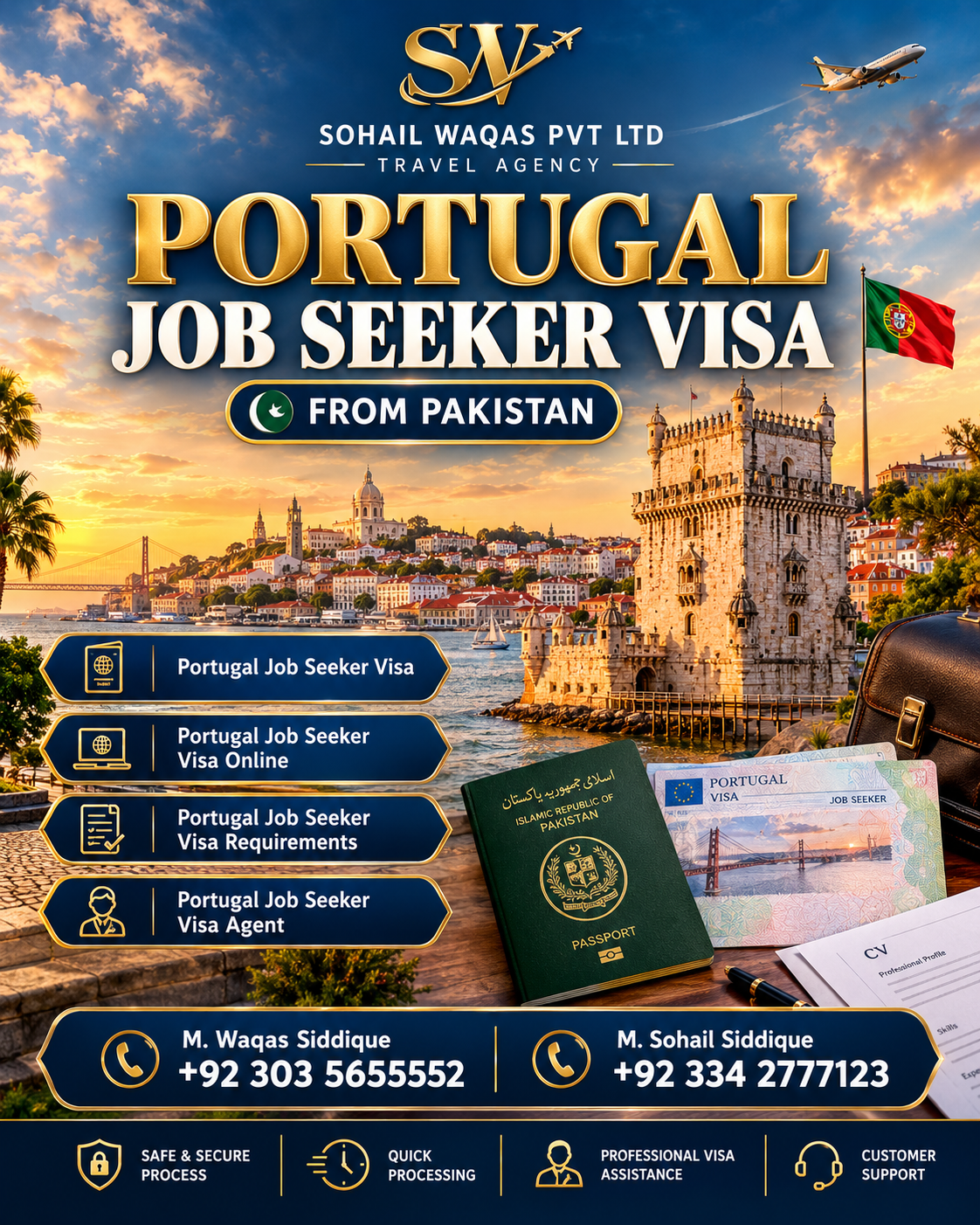
What Is the Portugal Job Seeker Visa?
The Portugal job seeker visa was designed for third-country nationals who wanted to enter Portugal specifically to look for employment.

Under the earlier system, an eligible applicant could travel to Portugal without having a finalized employment contract and use the visa period to search for a suitable job. The previous framework generally allowed a stay of 120 days, with a possible extension of 60 days under specified conditions.
However, that older system should not be treated as the current application route.
Following Law No. 61/2025, which entered into force on October 23, 2025, Portuguese legislation changed the category to a qualified/skilled job seeker visa. The law states that this visa may be granted to people with specialized technical skills and can allow the holder to enter Portugal for the purpose of seeking work.
This distinction is crucial.
Someone searching online for “Portugal job seeker visa requirements” may still find older checklists describing the previous general job seeker route. Those documents can be outdated and shouldn’t automatically be used for a new application.
What Changed in Portugal’s Job Seeker Visa Rules?
The biggest change is the move from a broad job-search route toward a system focused on skilled employment.
The revised law describes the new visa as a visa for seeking qualified work and refers to applicants with specialized technical competencies. It also provides a route for the holder to work in highly qualified employment during the visa’s validity period, subject to the applicable rules.
The practical result is that applicants should no longer assume that having a general education or simply wanting to find a job in Portugal is enough.
Your professional profile matters.
For example, an applicant with relevant technical education, professional certifications, specialized experience, and a clear career field may be better positioned than someone who has no defined professional specialization.
This is why your CV, academic background, professional experience, and intended occupation should all tell the same story.
Is the Portugal Job Seeker Visa Currently Available?
This is where applicants need to be particularly careful.
The old general job seeker visa was discontinued in its previous form after the October 2025 legislative change. Visa-service information published after the change states that applications under the previous job seeker category were no longer being accepted while the new skilled category awaited the necessary regulatory framework.
The Portuguese law itself establishes the new skilled job seeker category and sets out its basic legal framework.
Therefore, you shouldn’t rely on an old online checklist or an advertisement promising that anyone can simply apply for a general job seeker visa.
Before taking action, applicants should confirm whether the skilled category is operational for their nationality and location and whether the relevant Portuguese authorities have published the applicable procedures.
This is especially important for applicants from Pakistan because visa submission arrangements and appointment procedures can change.
Who May Benefit From the New Skilled Route?
The new framework is aimed at people with specialized technical skills.
Although the exact eligibility requirements should be checked against the rules applicable when you submit your application, a strong professional profile may include:
-
Relevant academic qualifications
-
Technical or professional certifications
-
Demonstrable work experience
-
A clearly defined occupation
-
Skills that match Portugal’s employment needs
-
A professional CV showing consistent experience
-
Evidence supporting your claimed qualifications
-
Properly prepared and legalized documents where required
Think of your application as a professional profile rather than simply a collection of documents.
If your CV says you’re an IT specialist but your education and employment records show something completely different, that can raise questions. On the other hand, when your education, certifications, experience, and intended career path fit together, your application becomes easier to understand.
Can You Apply Without a Job Offer?
This is one of the biggest reasons people search for this visa.
Historically, the job seeker route was designed around entering Portugal to look for employment rather than presenting a finalized employment contract at the initial stage.
The revised law still provides for a skilled job-seeking category, but applicants should not confuse this with ordinary employment residence visas.
Portugal also has specific residence visa routes for people who already have employment arrangements. The Portuguese government states that foreign nationals who want to work in Portugal generally need an appropriate residence title, while employment residence visas are connected to professional activity and may require a contract or promise of employment.
So there are two very different situations:
| Situation | Potential route |
|---|---|
| You already have qualifying employment | Work/residence visa |
| You qualify under the skilled job-search framework | Skilled job seeker route, subject to current availability |
| You plan to work independently | Independent professional activity route |
| You have highly qualified employment | Highly qualified activity route |
| You want to study first | Student residence route |
The right option depends on your circumstances.
Portugal Work Visa vs Job Seeker Route
A common mistake is assuming that every foreign worker should apply through the same category.
That’s not how Portuguese immigration works.
If you already have a Portuguese employer and a valid employment arrangement, a standard residence visa for subordinate employment may be more appropriate. The Portuguese government currently provides a specific service for residence visas for subordinate professional activity. If you are a highly qualified professional with an appropriate position, there are also routes for highly qualified employment. AIMA maintains a separate residence process for highly qualified professional activity.
The job-search route is different because its purpose is to give an eligible applicant a legal framework for entering Portugal to seek qualifying employment.
Choosing the wrong category can waste time and create unnecessary complications.
Key Documents You Should Prepare
The exact document checklist can change according to the visa category and the applicant’s circumstances. Still, preparing your professional documentation early is a sensible step.
A typical employment-focused immigration file may involve documents such as:
-
Valid passport
-
Completed visa application form
-
Recent passport photographs
-
Updated CV
-
Academic certificates
-
Professional certificates
-
Employment experience evidence
-
Criminal record documentation where required
-
Proof of accommodation where required
-
Proof of financial means where required
-
Health or travel insurance where applicable
-
Supporting declarations
-
Legalized or apostilled documents where applicable
-
Certified translations where required
Don’t wait until the appointment date to discover that your diploma or professional certificate needs additional authentication.
Document preparation can take time, especially when several authorities are involved.
Your CV Matters More Than You Think
For a skilled immigration route, your CV isn’t just a document you attach at the end.
It’s part of your professional evidence.
A good CV should clearly explain:
-
Your professional title
-
Your education
-
Your technical skills
-
Your work history
-
Relevant certifications
-
Major responsibilities
-
Industry experience
-
Languages
-
Contact information
-
The type of position you’re seeking
Avoid exaggerating your experience.
If you’ve worked as a network administrator, describe that role accurately. If you’re a software developer, list relevant technologies and actual experience. If you’re an engineer, clearly identify your engineering discipline.
Specific information is much stronger than vague statements such as “hardworking professional with many skills.”
Step-by-Step Preparation Guide
Step 1: Identify Your Professional Category
Start by asking a simple question:
What exactly can I offer a Portuguese employer?
Don’t begin with the visa form. Begin with your professional profile.
Write down your education, experience, certifications, technical abilities, and target occupation.
Step 2: Check Whether Your Profession Is Regulated
Some professions require specific qualifications or authorization before you can practice them in Portugal.
Healthcare, certain engineering fields, legal professions, and other regulated occupations can involve professional recognition requirements.
For highly qualified employment, Portuguese visa documentation can require evidence that an applicant is qualified to perform the relevant profession. For regulated professions, professional qualifications may need to be formally recognized under the applicable rules.
Step 3: Organize Your Supporting Documents
Create separate folders for:
-
Identity documents
-
Education
-
Employment
-
Professional certifications
-
Financial evidence
-
Accommodation
-
Police clearance
-
Insurance
-
Visa forms
This sounds basic, but it makes a major difference.
A messy file creates confusion. A well-organized file lets the reviewing authority quickly understand your case.
Step 4: Verify the Current Visa Category
This step is particularly important in 2026.
Don’t simply search for an old “job seeker visa checklist” and submit the same documents.
Portugal’s legal framework changed in 2025, so confirm that the category you’re applying for is currently open and that you meet its latest requirements.
Step 5: Use the Correct Application Channel
Portugal uses official consular and visa application channels for different visa categories.
For Pakistan, VFS Global identifies itself as the official partner of the Embassy of Portugal in Pakistan and provides visa application information and application-centre services.
Always verify the current submission procedure before booking an appointment.
Step 6: Prepare for Questions About Your Career
If an interview is required, be ready to explain:
-
Why Portugal?
-
What profession do you want to pursue?
-
What qualifications do you have?
-
What experience do you have?
-
What type of employers are you targeting?
-
Where will you stay?
-
How will you support yourself while looking for work?
Your answers should match your documents.
Common Mistakes Applicants Make
Mistake 1: Using Old Information
This is probably the biggest problem right now.
An article written before October 2025 may describe the previous general job seeker system. The law has since changed.
Always check the date of the information you’re reading.
Mistake 2: Believing Every Online Advertisement
Some advertisements make immigration sound simple:
“Get a Portugal job seeker visa without experience.”
“Guaranteed approval.”
“Visa guaranteed.”
Be careful.
No legitimate adviser can guarantee a visa decision made by Portuguese authorities.
Mistake 3: Submitting Inconsistent Documents
If your CV says one thing and your employment certificates say another, questions can arise.
Keep your information consistent.
Mistake 4: Ignoring Professional Recognition
A qualification from another country doesn’t automatically mean you’re authorized to practice every profession in Portugal.
Check whether your occupation is regulated.
Mistake 5: Treating the Visa as a Guaranteed Job
A visa for job seeking isn’t the same thing as an employment contract.
Even if you’re permitted to enter Portugal for the purpose of seeking qualifying employment, you still need to compete for jobs.
Your language ability, skills, experience, CV, networking, and interview performance can all matter.
How to Improve Your Chances of Finding Employment
Start preparing for the job search before travelling.
Research Portuguese companies in your field. Study the type of qualifications employers ask for. Improve your CV and LinkedIn profile. Learn basic Portuguese if your industry and target employers benefit from it.
English may be enough for some international positions, particularly in technology and multinational companies, but Portuguese can be valuable in many customer-facing and local roles.
Here’s what most people miss: finding a job is a separate project from getting immigration permission.
Treat both seriously.
Skills That Can Make Your Profile Stronger
Demand changes by industry, but specialized skills can generally make a professional profile more competitive.
Depending on your field, useful areas may include:
-
Information technology
-
Software development
-
Cybersecurity
-
Data and analytics
-
Engineering
-
Healthcare
-
Skilled technical trades
-
Construction-related technical roles
-
Renewable energy
-
Manufacturing
-
Logistics and specialized operations
This doesn’t mean that every occupation qualifies for a skilled immigration route.
Your actual qualifications and the applicable Portuguese rules determine eligibility.
What Happens After You Find a Job?
The immigration process doesn’t necessarily end when you receive an employment offer.
A person who enters through an applicable job-seeking framework must follow the relevant process for formalizing employment and, where eligible, applying for residence authorization.
AIMA currently explains that holders of a job-seeking visa who have established an employment relationship can apply for residence authorization, subject to the applicable requirements.
For ordinary employment residence authorization, AIMA lists requirements that can include a valid passport, the relevant residence visa, employer documentation confirming the employment relationship, and other residence requirements.
The exact documents depend on the route used.
What If You Don’t Find a Job?
Don’t assume that you can remain in Portugal indefinitely just because you entered through a job-search category.
The previous framework required applicants who failed to establish an employment relationship within the maximum validity period to leave Portugal, with restrictions on submitting another application for the same purpose. The revised law also provides for departure when the skilled job-seeking visa reaches its maximum validity without the required transition to employment and residence.
This is why preparation before travel is so important.
Use your time strategically:
-
Apply for jobs before travelling where possible.
-
Research employers.
-
Prepare multiple versions of your CV.
-
Build professional contacts.
-
Learn workplace Portuguese.
-
Understand your target industry.
-
Keep your documentation ready.
Benefits of a Skilled Job-Search Route
For someone who qualifies, the concept can offer several advantages.
1. A legal job-search framework
Instead of entering Portugal for an unrelated purpose and hoping to find work, the route is specifically connected to employment seeking.
2. Access to the Portuguese employment market
Being physically present can sometimes make interviews, networking, and employer communication easier.
3. Potential transition toward residence
The legal framework provides a mechanism through which qualifying employment can lead to a residence authorization application.
4. Opportunity to target skilled employment
The revised system is specifically oriented toward specialized technical competencies rather than a completely open job-search model.
Possible Challenges
There are also risks and limitations.
Limited time: A job-search visa isn’t an unlimited residence permission.
Competition: Portuguese employers can receive applications from many candidates.
Language: Some jobs require Portuguese.
Qualification recognition: Regulated professions may require additional recognition.
Changing regulations: Immigration rules can change, as the 2025 reform demonstrates.
Documentation: Missing, inconsistent, or incorrectly legalized documents can cause problems.
For these reasons, professional preparation is just as important as understanding the visa category.
Should You Apply for a Job Seeker Route or a Work Visa?
Ask yourself one question:
Do I already have a suitable job offer?
If the answer is yes, investigate the appropriate employment residence visa.
If the answer is no, and you’re interested in a skilled job-search route, first verify whether the applicable skilled job seeker category is operational and whether your professional profile meets its requirements.
If you’re already highly qualified and have an employer, another highly qualified employment route may be more suitable. Portugal maintains specific procedures for highly qualified professional activity.
A Practical Checklist Before You Start
Before beginning an application, review this checklist:
-
Valid passport
-
Updated professional CV
-
Clearly defined career field
-
Academic documents
-
Professional certificates
-
Employment experience evidence
-
Criminal record documentation if required
-
Financial documentation if required
-
Accommodation evidence if required
-
Insurance if required
-
Document legalization or apostille where applicable
-
Certified translations where applicable
-
Current visa category confirmed
-
Current submission procedure confirmed
-
Interview preparation completed
Don’t submit just because you’ve collected a pile of papers.
Submit when you understand why each document is in your application.
Final Advice for Pakistani Applicants
For applicants from Pakistan, the best strategy is to avoid relying on outdated social media posts or old visa checklists.
Portugal’s immigration system changed significantly in 2025. The old general job seeker system is no longer the right framework to describe the current rules, and the newer skilled category must be checked against the latest implementation and official instructions.
If your goal is to work in Portugal, start with your professional profile.
Ask yourself:
What job can I realistically get in Portugal, and what evidence proves that I’m qualified for it?
Once you can answer that clearly, selecting the appropriate immigration route becomes much easier.
A strong application isn’t about having the most documents. It’s about having the right documents, a credible professional profile, consistent information, and the correct visa category.
Portugal remains an attractive destination for international professionals, but immigration rules need to be treated seriously. If you’re considering a move, verify the current rules before making travel plans or submitting an application.
4. FAQ Section
Is the Portugal job seeker visa still available in 2026?
The previous general job seeker visa was changed by Law No. 61/2025. Portugal now has a legal framework for a skilled job seeker visa focused on specialized technical skills, and applicants should verify the current operational status and requirements before applying.
Can I apply for a Portugal job seeker visa without a job offer?
The purpose of the skilled job-seeking framework is to allow qualifying applicants to enter Portugal to seek suitable employment. However, the current eligibility rules and operational availability should be confirmed before submitting an application because the previous general category was replaced by the skilled framework.
What documents are needed for a Portugal job seeker visa?
Requirements depend on the applicable visa category and current rules. Applicants should generally prepare a valid passport, professional CV, education records, employment evidence, relevant certificates, and other supporting documents requested by the Portuguese authorities.
Can I get Portuguese residence after finding a job?
A qualifying employment relationship can allow an eligible holder of a job-seeking visa to apply for residence authorization, subject to the applicable legal requirements. AIMA provides a specific residence process for holders of a job-seeking visa who have established an employment relationship.
Is a job seeker visa the same as a Portugal work visa?
No. A work residence visa is generally used when the applicant already has qualifying employment arrangements, while a job-seeking route is designed around seeking employment. Portugal has separate residence visa categories for subordinate employment and highly qualified professional activity.
Can anyone apply for the skilled job seeker route?
No. The revised framework focuses on applicants with specialized technical competencies. Eligibility should be assessed according to the latest Portuguese legislation and implementing rules rather than assuming that every foreign worker qualifies.
https://sohailwaqas.com/portugal-job-seeker-visa-2026-guide-for-skilled-workers/
5. Contact Details
M. Waqas Siddique: +92 303 5655552
M. Sohail Siddique: +92 334 2777123